How to Lie With SUV Statistics

Shortly after I published my piece on the Mayor’s proposed SUV charge, London’s Walking & Cycling Commissioner posted this:

Let’s take the numbers seriously, because the source research – from the London School of Hygiene & Tropical Medicine – is legitimate. The findings come from a UK-specific study using STATS19 police crash data, and a broader international meta-analysis covering 680,000 collisions across 24 studies and 35 years.

The tweet presents three claims: SUVs are 14% more likely to kill an adult pedestrian, 77% more likely to kill a child, and 200% more likely to kill a child under 9 – all compared to a smaller car. Those are real findings, but the way they’re presented is a masterclass in how to make a modest statistical finding feel terrifying.

The biggest issue wit the tweet is that the base rate is invisible. Every one of those percentages is a relative risk – the increased likelihood of death given that you’ve already been hit by a car. That’s a conditional probability, and the condition is doing all the heavy lifting. Being struck by any vehicle as a pedestrian is rare. Being killed having been struck is much rarer. A child being killed by a vehicle in London is, mercifully, an extremely rare event – probably in the low single digits per year across the entire city.

London had around 100 road fatalities in 2024, of which roughly 40–50 were pedestrians. A subset of those involved children. A further subset involved vehicles classified as SUVs. A 77% increase applied to a number that is likely 2 or 3 per year means one or two additional deaths – each one a genuine tragedy1, but a very different policy proposition from what the tweet’s formatting (warning emojis, bold claims, a child dwarfed by a Range Rover) is designed to make you feel.

Not to reiterate my previous post too heavily, but the category is too broad to be useful. The studies define “SUV” broadly enough to include everything from a Nissan Juke (4,210mm long, 1,595kg) to a Range Rover Sport (4,946mm long, 2,300kg+). The physics of being struck by a vehicle with a bonnet height of 1,100mm is fundamentally different from being struck by one at 750mm. Averaging them into a single risk ratio washes out the very gradient that matters. A Hyundai Kona has more in common with a Volkswagen Golf than with the Range Rover in the tweet’s image – but the statistic treats them as the same kind of vehicle.

It’s also worth noting that the international meta-analysis – which produced higher, scarier numbers (44% for adults, 82% for children, 130% for under-10s) – drew 16 of its 24 studies from the United States, where “SUV” means something physically much larger than what that term captures in the UK fleet. The UK-specific study produced notably lower figures, which is exactly what you’d expect when the typical British “SUV” is a crossover rather than a Ford Expedition.

Further, the image he posted is arguing against the statistics: look at the photo attached to the tweet. A small child walking past a full-size Range Rover, its grille towering over her head. The image is implying that “this is what we’re talking about.” The 14% statistic is measuring something much broader and less dramatic – an average across every vehicle a manufacturer chose to market as an SUV, most of which are small crossovers that would barely register as threatening in the same photograph. The emotional case is built on the largest vehicles; the statistical net catches the smallest ones. This is the same move as the BBC using a mud-splattered Range Rover to illustrate a story about a policy that would mostly affect Nissan Qashqais.

None of this means the underlying research is wrong: larger, heavier vehicles with taller front profiles do cause more severe injuries in pedestrian collisions. That’s physics, and it’s well established. But if the concern is really about bonnet height and front-end geometry – and the research suggests it is – then the policy response should target bonnet height and front-end geometry. Not a marketing label that captures a Peugeot 2008 and a Range Rover in the same regulatory net while letting a 5,289mm Mercedes S-Class sail through untouched.

I don’t want to go too crazy with this series of posts and turn this blog into a ranting about the mayor zone. It just always really grinds my gears when see politicians use statistics in such a lazy and shallow way to justify whatever policy they want. I also would like to add that whilst I have seen some violence against statistics from Will Norman on Twitter before, I have also seen a striking amount of abuse aimed at him on there as well. As ‘Walking & Cycling Commissioner’ his job is advocacy for walking and cycling, in what should be a relatively milquetoast public service job – not this. Part of me feels disturbed that I am sitting here writing a defence of SUVs of all things! Like I don’t even like SUVs: they are boxy, not fun to drive and overpriced for what they are.2 I just wish we had better public policy and politicians who took what they are proposing and saying a lot more seriously.


  1. Please don’t get me wrong here: these deaths really are awful, especially when they are of children. But we make decisions to limit how much we would spend to save a given life all the time, and often at much lower rates than what is being proposed. ↩︎

  2. Especially Range Rovers! They are the embodiment of those three problems. Ugly too! ↩︎

Rebuttals I Expect to My SUV Piece

I published a piece earlier today arguing that the Mayor’s proposed SUV charge is badly targeted, poorly defined, and more about revenue than road safety. I stand by it, but I want to take the strongest counterarguments seriously rather than pretend they don’t exist.

Even if this specific charge is badly designed, don’t heavier vehicles impose real externalities that deserve some form of pricing?

Yes. I think they do. Heavier vehicles cause more road surface damage, generate more tyre-wear particulate pollution (which is now a larger source of PM2.5 in London than tailpipe emissions), and carry more kinetic energy in collisions. These are genuine externalities, and in principle some form of Pigouvian correction for vehicle weight is defensible.

But “an externality exists” does not justify any arbitrary policy that gestures in its general direction. The proposed charge isn’t a weight tax – it’s a tax on a marketing category. My Kona weighs about 1,610kg. My father-in-law’s Mercedes GLE weighs 2,300kg. A well-designed weight-based charge would distinguish between those vehicles. An “SUV charge” might catch both or neither, depending on whichever arbitrary definition the state lands on. If you want to price weight, price weight. Japan does this with curb weight taxes that are legible, hard to game, and actually change purchasing behaviour. That’s serious policy. Taxing a label is not.

There’s also a deeper point about what a Pigouvian tax is supposed to do. The ideal revenue from a correctly calibrated Pigouvian tax should trend towards zero over time – people change their behaviour, the externality diminishes, and the tax becomes unnecessary. Nobody at City Hall is talking about the charge in those terms, because the goal isn’t to eliminate the externality. The goal is to collect the revenue. That tells you what kind of policy this really is.

You say “just enforce against dangerous drivers instead,” but isn’t that much harder than you’re implying? The Mayor doesn’t fully control the courts or the police.

It is harder, and I should be honest about that. The Met has been in special measures, is short-staffed, and traffic policing has been hollowed out nationally for over a decade. The courts are independent and have their own sentencing culture – the Mayor can’t order magistrates to stop exercising discretion for drivers on 30+ points. Real enforcement requires a chain of state capacity (ANPR infrastructure, police resources, court time, DVLA coordination) that no single politician fully controls.

But this actually makes the case against the SUV charge stronger, not weaker. If the Mayor genuinely lacks the capacity to address the main sources of road danger, then the honest response is to say so and argue for the resources and powers needed to fix that. Instead, the pattern is: acknowledge the real problem, discover it’s hard to solve, and then pivot to a symbolic policy that is within your administrative reach but doesn’t address the original problem. The victims of the tax aren’t the perpetrators of the harm. If your best argument for a policy is “it’s the thing we can actually do,” you should at least be transparent that it’s a second-best substitute rather than presenting it as though it directly targets the thing you claim to care about.

The Mayor is also, nominally, in charge of the Metropolitan Police. He sets their budget and appoints the Commissioner. He has significant soft power within the Met and within the Labour Party nationally. “I can’t do the hard thing” is at least partly a choice about where to spend political capital – and choosing to spend it on a surcharge rather than on traffic enforcement tells you something about priorities.

Doesn’t “more enforcement” also have problems? More ANPR cameras, more police stops, more state intrusion into people’s driving – is that really the liberal alternative?

This is a fair challenge, and I want to be honest about where I actually land. In the main piece I present enforcement against dangerous drivers as the obvious alternative to the SUV charge. That’s partly genuine – I do think ghost plates, uninsured drivers, and repeat offenders are undertargeted – but it’s also partly rhetorical. I introduced those examples as counterfactual weight: to show that if road safety is really the goal, there are higher-impact interventions available. It would be dishonest to pretend I’m enthusiastically calling for a major expansion of traffic policing.

My real view is closer to: London’s roads are already among the safest in the world, the trend is improving, and the case for any major new intervention – whether a tax or an enforcement push – is weak. If the choice is between an SUV charge and a weight-based charge, the weight-based charge is obviously better designed. But if the choice is between an SUV charge and doing nothing, I’d take doing nothing. The baseline is good. The trajectory is positive. Not every problem requires a new policy instrument, and the deadweight loss from a badly designed intervention can easily exceed the externality it’s meant to correct.

That probably makes me unusual in this debate, where both sides tend to agree that Something Must Be Done and only disagree about what. But I think “the current situation is acceptable and improving” is a legitimate position that deserves more airtime than it gets.

Your “optimal level of road deaths is non-zero” framing is analytically tidy but morally callous. Try telling that to the family of someone killed last year.

I take this seriously, and I should have been more careful about it in the original piece.

Every road death is a tragedy. Driving is far more dangerous than people appreciate – vastly more dangerous per mile than flying, for instance – and we’ve collectively normalised a level of risk that would be considered scandalous in almost any other domain. The 1,600 people killed on British roads last year were real people with families, and each of those deaths was preventable in the sense that specific decisions, designs, or enforcement failures contributed to it.

The analytical point still holds: a city that tried to reach literally zero road deaths would have to impose restrictions so severe – speed limits in the single digits, total pedestrianisation of most streets, effective prohibition of goods vehicles – that the cure would be worse than the disease. That is what Patrick McKenzie’s insight means when applied here. But I should be clear that this is a statement about the limits of policy, not a statement about the value of the lives lost. The fact that zero is not an achievable target does not mean we shouldn’t grieve every death or pursue every cost-effective intervention that would prevent one.

Where I part company with Vision Zero advocates is not on the moral seriousness of road deaths but on whether a parking surcharge on “SUVs” is a cost-effective intervention. I don’t think it is. And I worry that the rhetorical power of “Vision Zero” – the implication that anyone who questions a specific policy under its banner is indifferent to human life – is being used to shut down exactly the kind of cost-benefit scrutiny that good policy requires. Caring about road deaths and questioning whether this particular charge will prevent any are not contradictory positions.

Forget road safety – the climate case for discouraging large, heavy vehicles is separate and stronger. Heavier vehicles consume more energy, require more materials to manufacture, generate more particulates, and take up more space. Even if the safety argument is weak, the environmental argument holds.

There’s something to this, and it’s probably the strongest version of the case for doing something about vehicle size. But I still think it’s more cakeist than it first appears, and insufficiently honest about the actual trade-offs in the state’s relationship with the public.

Start with the counterfactual. A heavier vehicle that is also electric has massively cut the real environmental harm compared to the petrol or diesel car it replaced. My Kona is heavier than a petrol Golf, but it produces zero tailpipe emissions, dramatically less lifetime CO2 (even accounting for battery production and grid mix), and no NOx or direct particulate exhaust. If you genuinely care about the climate, you should be willing to swallow cars being 20% heavier if that’s the price of a greener fleet arriving sooner. The weight gain from electrification is a transitional cost, not a permanent one – battery energy density is improving and vehicles will get lighter as the technology matures.

Now consider what the policy environment actually looks like for EV owners. The government is already planning to introduce per-mile charging for electric vehicles, ostensibly to replace lost fuel duty revenue. So the externality of road use is already going to be taxed through a new mechanism. Layer an SUV surcharge on top and you’re double-taxing EV crossover owners – once for using the road, once for the shape of their car – while simultaneously undermining the economic case for switching to electric in the first place. The counterfactual of a taxed-away SUV EV might not be a smaller EV. It might be someone hanging on to their old diesel saloon for another five years. That would be worse for the climate by every measure.

And if we’re being honest about where the revenue goes: it would be one thing if these charges funded new Underground lines, better bus networks, or the kind of public transport investment that gives people genuine alternatives to driving. But they don’t. The Department for Transport’s budget is frozen in nominal terms, which is a real-terms cut. TfL is in a perpetual funding crisis. The revenue from motoring charges goes into plugging operational deficits, not building the infrastructure that would make cars less necessary. We’re taxing the current system without investing in the alternative.

Air pollution is a serious problem. But the primary culprits are still petrol and diesel vehicles, not electric crossovers. The tyre particulate issue is real but emerging, and the right response is investment in low-emission tyre technology and road surfaces – not a surcharge on a marketing category that will do nothing to accelerate that research. If the environmental movement wants to be taken seriously on vehicle policy, it needs to stop reaching for punitive taxes on consumers who are already making the transition it asked for, and start demanding the infrastructure investment that would make the transition work.

London voters keep re-electing Khan. Parisians voted for the surcharge. Isn’t there genuine democratic demand for anti-car policies in dense cities?

You can’t reason from electoral performance to policy endorsement. People vote on bundles, not individual line items. London’s electoral map is shaped by housing tenure, demographics, and party identity in ways that have very little to do with motoring policy. The borough council estates (London has the highest concentration of social housing in the country) aren’t going to swing to the Conservatives over parking charges, regardless of what residents think about cars specifically. People vote for Labour because they believe Labour will legislate in their interests broadly – not because they’ve carefully evaluated the Mayor’s transport proposals.

The Paris example is even weaker than it first appears. The surcharge passed on 5.7% turnout – about 42,000 people out of 1.3 million eligible voters. Parisian residents were exempt from the charges entirely. So a small, self-interested minority voted to impose costs exclusively on people who weren’t allowed to participate in the vote. That’s not revealed democratic preference; it’s a structural incentive problem baked into the referendum design.

And if we’re invoking democratic legitimacy: turnout in London mayoral elections has been falling steadily. That’s not a ringing endorsement of the Mayor’s agenda. Low and declining participation suggests disengagement, not enthusiastic consent.

The fertility argument is a stretch. Nobody is deciding not to have a baby because SUV parking went up.

That’s trivially true and too trivial an example. Of course no individual parent is sitting down with a spreadsheet, pricing out the SUV surcharge, and concluding they can’t afford a third child. That is not the argument.

The argument is about the cumulative policy environment. London is a city where the housing stock is dominated by one- and two-bedroom flats (which mechanically suppress you to one or two children respectively). Childcare costs are among the highest in the country. The transport network is optimised for modes that are hostile to small children – try getting a double buggy onto a bus at rush hour, or cycling with a toddler on the back through Elephant and Castle. Research suggests that car seat regulations reduce third-child fertility, not because anyone consciously decides against it, but because the logistics of three-child family life become fractionally harder at every margin, and those frictions compound.

The SUV surcharge is one more thumb on the same side of the scale. It makes owning the category of car most likely to fit three car seats a bit more expensive, in a city that has already optimised itself against families at almost every other level. As Everett Dirksen supposedly said: “A billion here, a billion there, and pretty soon you’re talking real money.” No single policy is the cause. But the aggregate policy direction describes a city that has systematically deprioritised families – and Inner London’s fertility rate of 1.16 is the long-run scoreboard.

The strongest version of my argument isn’t “the SUV charge will reduce the birth rate.” It’s that London’s political class has revealed, through decades of cumulative policy choices, that families with children are not who the city is being designed for – and the fertility data is the consequence, not of any one decision, but of all of them together.

You dismiss the tyre-wear particulate argument too quickly. EV weight is a real and growing problem.

Fair. I should engage with this more directly. Tyre and brake wear particulates are now estimated to be a larger source of PM2.5 in London than exhaust emissions, and this problem gets worse as the fleet electrifies because EVs are heavier (batteries are heavy). My Kona is about 350kg heavier than an equivalent petrol Golf. That’s a real difference in road wear and particulate generation.

But here again, the proposed policy doesn’t actually target this. If tyre-wear particulates are the concern, then the relevant variable is vehicle weight, not whether the manufacturer calls it an SUV. A 1,260kg petrol Golf produces fewer tyre particulates than my 1,610kg electric Kona, which produces fewer than a 2,300kg Mercedes GLE. A weight-based levy would capture that gradient. An “SUV charge” would not – it would catch some light crossovers and miss some heavy saloons, in exactly the pattern you’d want to avoid.

The longer-term answer is probably investment in low-particulate tyre technology and road surface design, neither of which a parking surcharge addresses. But in the near term, if you want to price this externality, price it by weight. The tool exists. The Mayor just isn’t reaching for it – probably because a weight-based charge would also catch a lot of vehicles whose owners he’d prefer not to antagonise.

The Mayor Wants to Tax a Marketing Term

I am not a big fan of the Mayor of London, and found myself once more dismayed by him by learning that he is considering new charges for SUV drivers. A Vision Zero action plan published by Transport for London floats the idea of higher parking fees or surcharges for SUVs, following lobbying by the campaign group Clean Cities and taking cues from Paris, which tripled SUV parking charges in 2024.

The case, as TfL presents it, runs something like this: SUV registrations in London have grown roughly 40% since 2020. TfL’s own research claims these vehicles create “intensifying risks across London.” City Hall says SUVs are much more likely to kill a pedestrian than smaller cars if involved in a collision, that their higher bonnets create dangerous blind spots (particularly for children), and that they take up more road space and contribute more to tyre-wear particulate pollution. The stated goal is road safety – fewer deaths, fewer serious injuries – under the Mayor’s Vision Zero target of eliminating all road fatalities by 2041.1

Noble aims! But the policy, as proposed, is a mess – built on vague definitions, imported American anxieties, and a revenue motive dressed up as road safety.

The definition problem

This is the question that should end the conversation before it starts, but somehow never does. There is no legal definition of an SUV in the UK. The term “sport utility vehicle” is a marketing category, not a regulatory one. The Society of Motor Manufacturers and Traders calls them “dual purpose” vehicles, which is about as precise as calling something “food.”

I drive a 2021 Hyundai Kona Electric. On the DVLA database, it is classified as an SUV, because that is how Hyundai chose to market it. In reality, it is 4,180mm long and 1,800mm wide. A Volkswagen Golf – the ur-hatchback, the car that says “I am a normal person making normal choices” – is 4,284mm long and 1,789mm wide. My SUV is shorter than a Golf. It is eleven millimetres wider. It produces zero tailpipe emissions. If you saw it in a car park you would not think “that’s one of those menacing SUVs the Mayor is worried about.” You would think “that’s a small car.”

And the Kona is not unusual. The growth in SUV registrations in London (roughly 40% since 2020, from about 693,000 to 974,000 according to Clean Cities) is not being driven by people buying Range Rover Defenders and Ford F-150s. It is overwhelmingly driven by crossovers: Kia Niros, Nissan Qashqais, Hyundai Konas, Peugeot 2008s. Cars that are, in every meaningful dimension, hatchbacks that sit a couple of inches higher off the ground. The BBC article’s header image is a mud-splattered Range Rover. The median “SUV” on a London street is a Nissan Juke.

Good tax policy needs a base that is legible and hard to game. “SUV” is neither. The state would either have to rely on manufacturer labelling (which is arbitrary and changes with marketing trends) or invent some new technical definition, which would immediately produce absurd boundary cases. Is a Skoda Karoq an SUV? What about a Volvo V60 Cross Country, which is an estate with plastic cladding? Where exactly is the line?

More importantly, any hard boundary creates an incentive to game it. Public choice economists from James Buchanan to Gary Becker have documented how tax classifications reliably produce exactly this kind of strategic relabelling. The American experience is the cautionary tale par excellence: US fuel economy regulations drew a line between “passenger cars” and “light trucks,” with the latter subject to weaker emissions and safety standards. The result was not fewer trucks, but a decades-long shift by manufacturers towards vehicles classified as light trucks, because that’s where the regulatory advantage lay. The Chicken Tax – a 25% tariff on imported light trucks dating back to a 1960s trade war over poultry – further distorted the market, with manufacturers going to extraordinary lengths to reclassify vehicles. Subaru bolted rear-facing seats into the bed of the BRAT to get it classified as a passenger vehicle. Ford shipped Transit Connects from Turkey with seats installed, only to strip them out dockside in Baltimore – a scheme that eventually cost them $365 million in fines. If London introduces an “SUV charge,” the most predictable outcome is not fewer large vehicles. It is manufacturers relabelling their crossovers as something else, while the vehicles themselves remain identical.

The perverse incentives don’t stop at labelling. Depending on the design, the charge could actively encourage people to hang on to older, dirtier, less safe vehicles rather than switch into newer ones that happen to be classified as SUVs. A 2015 diesel Ford Mondeo Estate would likely escape an SUV surcharge, while a brand-new zero-emission Hyundai Kona Electric would be caught in the net. If road safety and environmental outcomes are really what we’re after, this gets the incentives exactly backwards. And consider: a Mercedes-Benz S-Class (a petrol-powered luxury saloon) stretches to 5,289mm long and 1,921mm wide – over a metre longer and 120mm wider than most mid-size crossover SUVs. It would almost certainly escape an “SUV charge.” My 4,180mm electric Kona would not. The policy is targeting a marketing label, not the physical characteristics it claims to care about.

Politicians also talk as if every buyer is standing in a showroom choosing between a supermini and a hulking 4×4 on equal terms. In reality, the market has already moved. Manufacturers have shifted production decisively towards crossovers – they now account for over half of new vehicle registrations in Europe. Walk into a Hyundai, Kia, or Peugeot dealership today and crossovers dominate the range. The superminis are being discontinued or de-emphasised. This is even more pronounced in the used-car market, where most purchases actually happen. The pool of available vehicles reflects what was manufactured three, five, seven years ago. Penalising buyers for responding to a product mix they had no role in shaping is punishing people after the fact.

Britain is not America

There is a genuine problem with vehicle size in the United States. American pickup trucks and full-size SUVs have grown dramatically over the past two decades. A modern Ford F-150 is taller than a Second World War Sherman tank. American pedestrian fatalities have risen sharply, and there is real evidence linking this to vehicle size, hood height, and poor forward visibility.

But here’s the thing: Britain is not America! Our roads are much, much safer already! Patrick McKenzie has an essay called “The optimal amount of fraud is non-zero,” and the core insight generalises well beyond payments: the cost of eliminating the last few cases of any bad outcome can vastly exceed the benefits, especially when the baseline is already low. The UK had roughly 1,600 road deaths in 2024 across the whole of Great Britain – the lowest figure on record outside pandemic years. The UK sits at 25 deaths per million inhabitants, fifth-lowest in Europe, behind only Norway, Sweden, Malta and Denmark. London specifically is even safer, with serious injuries 24% below the 2010–14 baseline. The majority of UK road fatalities – 60% – happen on rural roads. They are not being caused by Nissan Qashqais in Kensington.

I think of this as West Wing Brain: the tendency of British politicians to import American culture war battles wholesale, without checking whether the underlying conditions apply here. America has a genuine vehicle-size crisis driven by regulatory loopholes, tax incentives, and a fundamentally different automotive culture. We have a crossover-popularity trend driven by practical consumer preferences in a country where the best-selling vehicle is a Vauxhall Corsa. If you genuinely want to target the attributes that matter for pedestrian safety – vehicle mass, bonnet height, front-end profile, sightlines – then regulate those variables directly. Don’t tax a marketing category and hope it approximates the right thing.

People are choosing crossovers over superminis for reasons that are entirely rational. You get more boot space. You sit higher, which is easier on ageing joints. You can fit three child seats across the back row, which you cannot do in most superminis. As incomes rise, it is not some moral failing that people stop buying Kia Picantos. It’s just revealed preference.

This matters particularly for families, and London has a fertility problem that dwarfs anything the SUV discourse is grappling with. London’s total fertility rate was 1.35 in 2024, and Inner London was at an astonishing 1.16 – the lowest of any region in England by a wide margin. England and Wales as a whole hit 1.41, the lowest since records began in 1938. Schools across Inner London are merging and closing because there aren’t enough children. Making it more expensive for families to own a car with enough space for children and a pushchair is not going to help with any of this. It is pouring petrol on a fire to warm your hands.

Then there’s the EV transition paradox. For years, the government has been spending billions to incentivise the switch to electric vehicles – grants, tax breaks, the ULEZ expansion. And what do many popular EVs look like? Crossovers and SUVs. The Hyundai Kona Electric. The Kia Niro EV. The MG ZS EV. The Tesla Model Y. This is not a coincidence: most EVs are designed as crossovers because the “skateboard” battery chassis naturally produces a vehicle that sits higher. The platform dictates the form factor. By taxing the SUV shape, the Mayor would effectively be penalising the exact vehicles he has been subsidising and encouraging through ULEZ. We told people to buy electric crossovers, they did, and now we’re going to charge them more for it.

A lot of City Hall policy is written with Zone 1–2 assumptions and then imposed on people in less well-served parts of outer London. Inner London has the Tube, dense bus networks, and walkable high streets. Outer London has orbital bus routes that run every twenty minutes, patchy rail coverage, and journeys that involve awkward interchanges or no public transport option at all. There are still many journeys – school runs with small children, weekly shopping, visiting older relatives, anything involving a buggy and two bags – where a car is simply more practical2. The burden of another motoring charge would not fall evenly across London. It would land heaviest on the people with the fewest alternatives. London already has the congestion charge, ULEZ, residential parking permits, and some of the most expensive parking in Europe. Each was introduced with safety or environmental justifications. Each has become, over time, primarily a revenue mechanism. The SUV surcharge is the next layer of the same cake.

Revenue dressed as safety

The stated justification is Vision Zero – the goal of eliminating road deaths entirely by 2041. But how, precisely, does a parking surcharge on “SUVs” achieve this? The causal mechanism is never spelled out, because it doesn’t really exist.

At the margin, some people might choose a slightly smaller car. But marginal shifts in new car purchases will take years to flow through the fleet. Meanwhile, the charge will be paid by people who already own the car, which means it functions as a pure revenue extraction with no behavioural change. And the tell is that nobody is saying “the revenue raised will be hypothecated for road safety improvements.” There is no commitment to better junction design, more traffic enforcement officers, or upgraded pedestrian crossings. The tax is presented as if the act of collecting it is itself the intervention. This is political cakeism from a Mayor who has elevated cakeism to an art form.

Paris already tried this. The vote passed on 5.7% turnout, with Parisian residents themselves exempt from the charges – a lovely bit of NIMBYism where inner-city voters imposed costs exclusively on people driving in from outside. Even France’s own Environment Minister called it “punitive environmentalism.” Despite the policy, SUV sales across Europe have continued to climb. The policy did not change behaviour! It ended up being more performative greenwashing3 than real positive change.

A recurrent problem in British policy is going after easy-to-observe proxies rather than costly-to-enforce actual misconduct. It is administratively easier to slap a surcharge on a lawfully registered, insured car than to clamp down on uninsured drivers, cloned plates, hit-and-run offenders, serial speeders, and repeat drink-drivers. But easier is not the same as effective. Only about 7% of the UK’s 50 million driving licence holders have any points on their licence at all. But within that 7%, there are people with 30, 40, even 51 points who are still on the road, because magistrates routinely exercise discretion to avoid disqualification. The DVLA’s own data suggests 90% of drivers not disqualified at 12+ points retain their licence through judicial discretion. The courts’ leniency towards dangerous drivers is a documented scandal. Lifetime bans for repeat serious offenders would do more for road safety than any number of parking surcharges. Ghost plates, uninsured drivers, unlicensed drivers, drink drivers 4 – these are the populations that disproportionately cause serious harm. Targeting them requires enforcement, which requires spending. It is less photogenic than announcing a new charge on a category of vehicle that people love to hate, but it is where the actual gains are.

Better junction design matters too. The majority of pedestrian and cyclist fatalities in London happen at junctions, and many of those junctions have known design deficiencies. Protected cycle lanes, better sight lines, Dutch-style junction treatments – these are infrastructure investments with proven safety records. None of this is as politically convenient as a surcharge on “SUVs.” Enforcement is expensive and invisible. Infrastructure takes years. But they work, and a vaguely-defined surcharge on a marketing category does not.


The great irony of the Mayor’s ‘Vision Zero’ is that it lacks actual vision. It ignores the January 2026 Road Safety Strategy’s own findings: that the real threat on our roads isn’t the height of a family car’s bonnet, but the 26,000 repeat drink-drivers and the 11% surge in uninsured vehicles that the current system is failing to stop.

London does not have an SUV problem so much as it has a political class that prefers symbolic proxies to precise interventions. The vehicles being swept into this category are often not especially large, not especially polluting, and not especially dangerous by any sensible British standard. What makes them attractive targets is not that they are the main source of road danger, but that they are visible, unpopular in the right circles, and easy to tax.

If City Hall were serious about reducing deaths and serious injuries, it would focus on the things that actually drive them: dangerous junctions, repeat offenders, uninsured and unlicensed drivers, and the small minority of motorists who generate a disproportionate share of the harm. Those measures are harder, costlier, and less photogenic than a surcharge on “SUVs”. They also happen to be more likely to work. 5

That is the real objection here. This is not a serious safety policy aimed at the main sources of risk. It is a badly targeted tax built around a vague marketing category, justified with imported imagery and moral theatre. London can have safer roads, or it can have another performative motoring surcharge. What it should not do is confuse the latter for the former.

I wrote two companion posts alongside this one: Rebuttals I Expect to My SUV Piece, where I steelman the strongest objections to my argument and respond to them honestly, and How to Lie With SUV Statistics, where I look at how London’s Walking & Cycling Commissioner presented the safety data underpinning this proposal.


  1. There is a lot more to this, but I will focus more on the SUVs proposal because I think it is is one of the weaker elements. ↩︎

  2. I hesitated writing this as the “practical” nature of cars can be exaggerated by car advocates and open to legitimate criticism. The bigger point is that deciding what’s a ‘practical’ choice should be the remit of London’s residents rather than a paternalistic Mayor’s office. ↩︎

  3. Then again that is often Sadiq Khan’s modus operandi. ↩︎

  4. Interestingly drink driving is much less of a problem than it once was, further to my point that Britain’s roads are already unusually safe in reality ↩︎

  5. I really like Japan’s curb weight taxes. They are legible, vastly more targeted, actually change behaviour for the better, and basically impossible to avoid if you want a bigger car. But then again, that isn’t really the kind of taxation that the mayor has the ability to introduce. Also, because the population has adapted to them, they don’t actually raise that much revenue (only about 0.3% to 0.6% of Japan’s total national budget). ↩︎

Reclaiming the Green Button

The green traffic-light button on macOS used to do something genuinely helpful – or at least a lot more helpful than what it does now. You’d click it, or Option-click it, and your window would grow to a sensible size. Usually it would make the window grow taller. Maybe a bit wider if the app thought it needed it. The window remained a window. You could still see the desktop behind it, still click on another app, still reach the Dock. It was called Zoom, and though not without its critics, in retrospect it was one of those quiet, well-judged interface decisions that you never thought about until it was gone.

It is now very much gone. Apple broke it twice, a decade apart, and if – like me – you skipped a few macOS versions, the experience of returning to macOS at Tahoe can be very annoying.

Break 1: Yosemite (2014)

In OS X Yosemite (10.10, October 2014), Apple changed the green button from Zoom to Full Screen. Clicking it no longer resized the window sensibly – it banished the entire app into its own Space, complete with a sluggish animation, no Dock, no menu bar, and no ability to click on anything else. The old Zoom behaviour was demoted to a modifier: hold Option, click the green button, and you’d get the old resize-to-fit behaviour. Annoying, but workable. For the next eight years – through El Capitan, Sierra, High Sierra, Mojave, Catalina, Big Sur, and Monterey – Option-click on the green button reliably triggered the old Zoom. Muscle memory adapted. Life went on.

Break 2: Sequoia (2024) – the really bad one

In macOS Sequoia (15, September 2024), Apple changed the green button again. Hovering over it now produces a popover menu offering to tile the window into halves, quarters, or various arrangements. Option-clicking no longer triggers the old Zoom – it now performs a “Fill”, which snaps the window to the full screen dimensions (width included) with tiling margins.

The old Zoom behaviour, the one that had survived as a modifier-key workaround since 2014, was quietly removed from the green button entirely.1

None of this is a new complaint. People have been annoyed about the green button since 2014. There’s a well-known OSXDaily guide from the Yosemite era showing how to remap it with BetterTouchTool, a long-running MacRumors thread full of people who just want a maximize button, several posts on the BTT community forums asking for vertical-only maximisation, and a TidBITS piece on taming Sequoia’s tiling. But as far as I could find, nobody has stitched all the pieces together into one guide – specifically: intercepting the green button on Sequoia or Tahoe, using a script that makes the window full height while preserving its width, working around the tiling popover, and explaining why the simpler approaches (BTT’s built-in Zoom action, Option-click) no longer work. So here we are.

What I actually want

Vertical space on a laptop is precious. Most applications don’t benefit from being wider than they already are – think for example of messaging apps, Finder in list view, Transmission, BBEdit, even System Settings (which hilariously can’t be resized horizontally, making it the only app that already behaves the way I want). What I want is dead simple:

Keep the window’s current width. Make it full height.

Top of the usable screen to just above the Dock (which in my case is on auto hide and show, so it rises to the full height of the screen minus the menu bar). No tiling. No full-screen Space. No change to horizontal position or width. Just: be taller.

The old Zoom behaviour often did exactly this, or close enough. Apple took it away and replaced it with something designed for people who want their Mac to work like a tiling window manager or, worse, like an iPad.

I don’t use tiling – the odds of any given app’s content fitting neatly into exactly half or a third of the screen width are vanishingly low, and plenty of apps actively degrade their UI when constrained this way (collapsing sidebars, hiding controls, reflowing content into unreadable columns). I don’t use Full Screen – it locks you into a Space, hides the Dock, and removes the ability to click off the app to switch to another. It is the single-tasking paradigm that the Mac was invented to escape.2 ‘Fill and Arrange’, one of the options in the green button’s dropdown menu, comes closest to what I want – but not quite, because it still snaps the window to a predetermined width that has nothing to do with the application’s content, and if you drag the window to rearrange it, it resets to its previous size.

Incredibly, even resizing manually by dragging doesn’t reliably work. If you leave Tiling enabled, dragging a window toward the menu bar – you know, so you can start making it full height – causes macOS to tile it instead. For something like a browser window, that can mean being crushed into an unusably narrow half-screen width. And if you then try to move it, it resets to its previous size. You genuinely cannot win.

Enter BetterTouchTool

BetterTouchTool (BTT) is a macOS utility that lets you remap and customise almost every input on your Mac – trackpad gestures, keyboard shortcuts, mouse buttons, Touch Bar, and crucially for our purposes, the window traffic-light buttons. It’s been around since 2009, has a 45-day trial and costs $15 for two years of updates or $25 for a lifetime licence. Though it has what I can only describe as an interface that is obtuse at the best of times, and has definitely become worse with the transition to Liquid Glass, the tool itself is quite powerful, and adds a whole suite of customisation options that I wish I didn’t have to download a third party application to do.

Critically, BTT can intercept a click on the green window button and replace the default macOS behaviour with any action you choose. That’s exactly what we need.

Step 1: Create the trigger

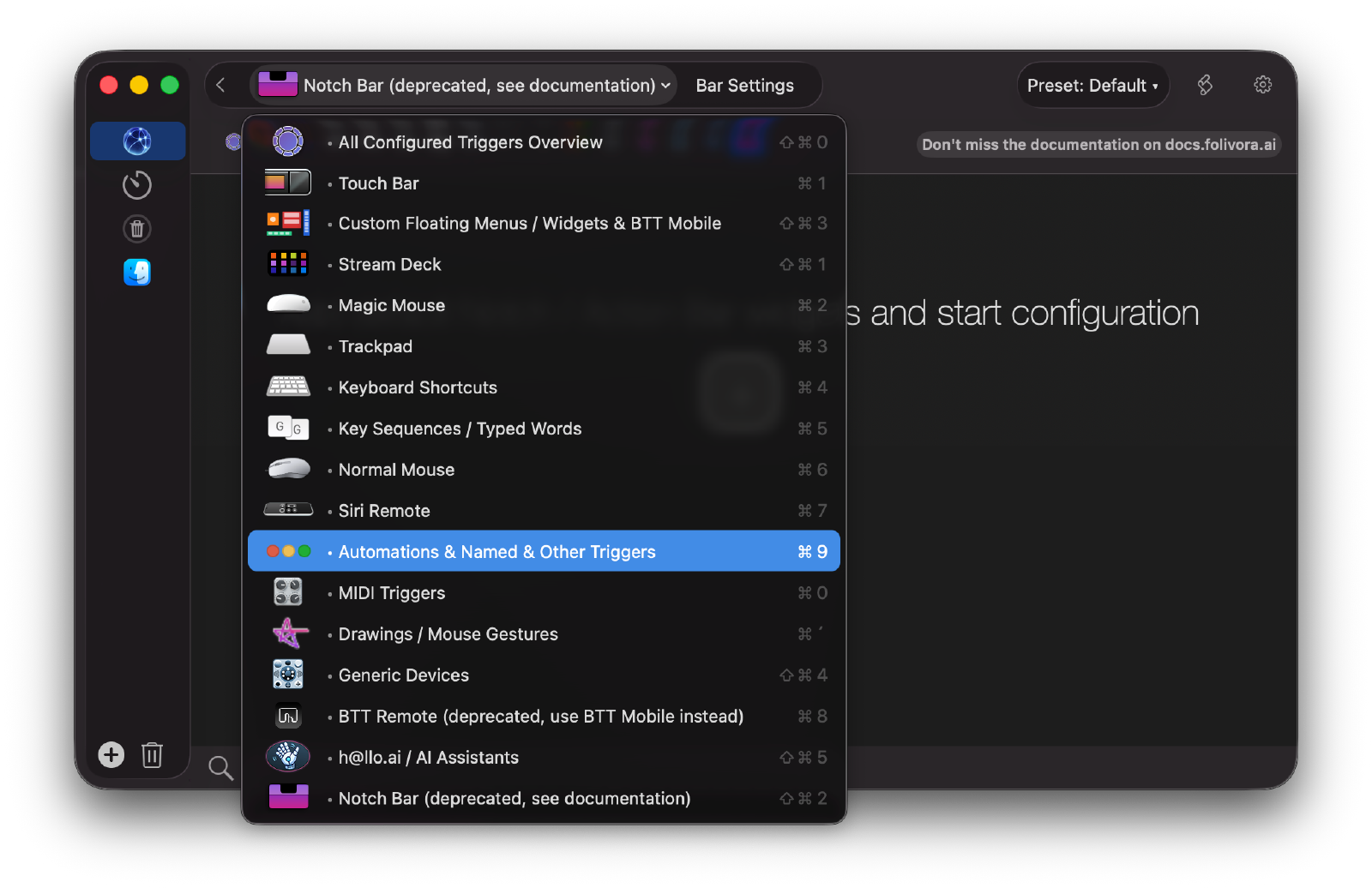
Open BetterTouchTool’s configuration window. In the top bar, click “Automations & Named & Other Triggers” – it’s the section for special triggers that don’t fit into the trackpad/mouse/keyboard categories.

The BetterTouchTool configuration window with “Automations & Named & Other Triggers” selected in the top bar

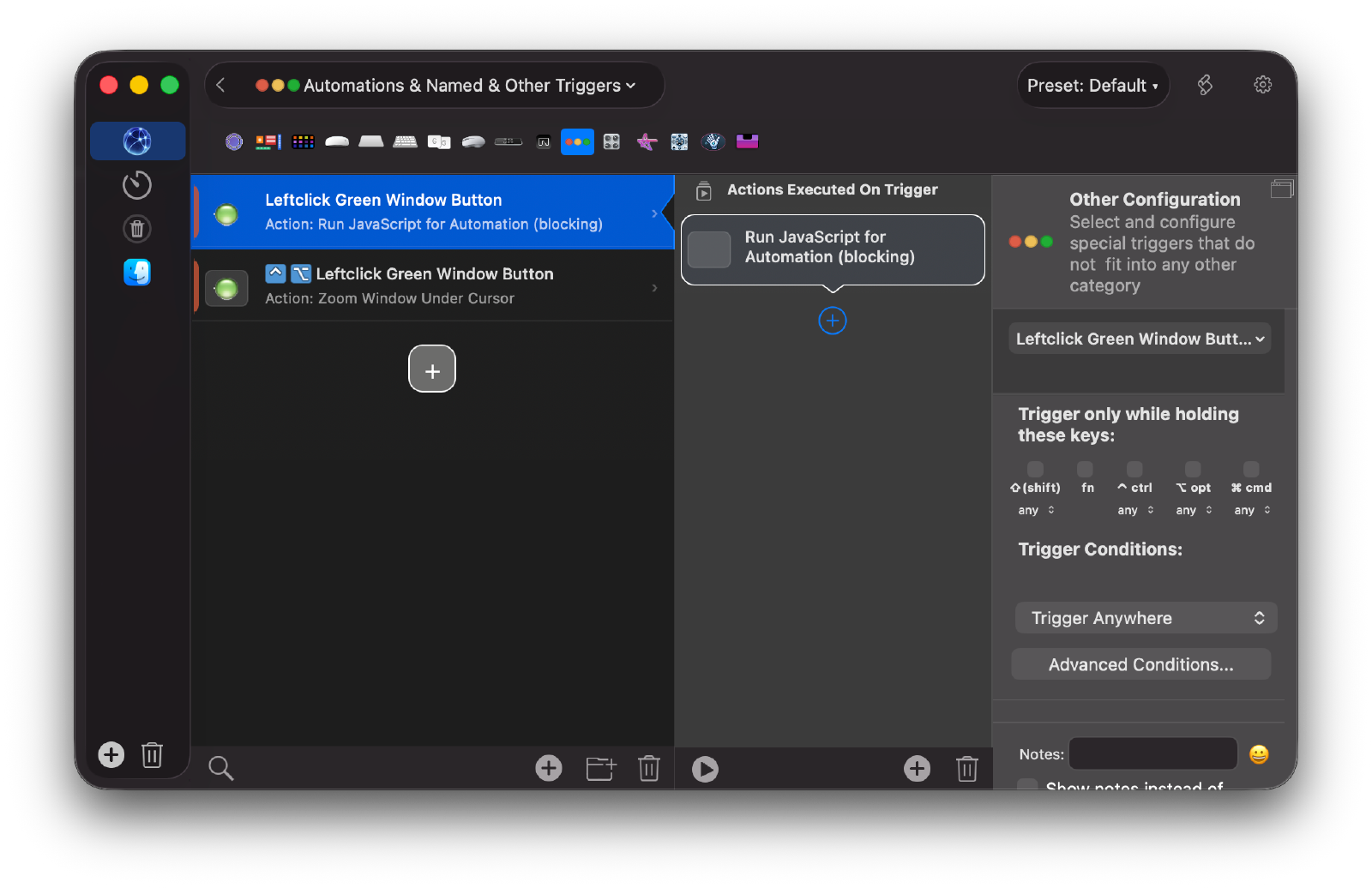
Click the "+" button at the bottom of the left-hand trigger list. In the trigger type picker, select “Leftclick Green Window Button”. This creates a trigger that fires only when you click the green dot on any window’s title bar – not on any other left-click anywhere else.

The trigger type picker with “Leftclick Green Window Button” selected

Step 2: Set up the action

With your new trigger selected, click the action area on the right to add an action. Choose “Run Apple Script (blocking)”.

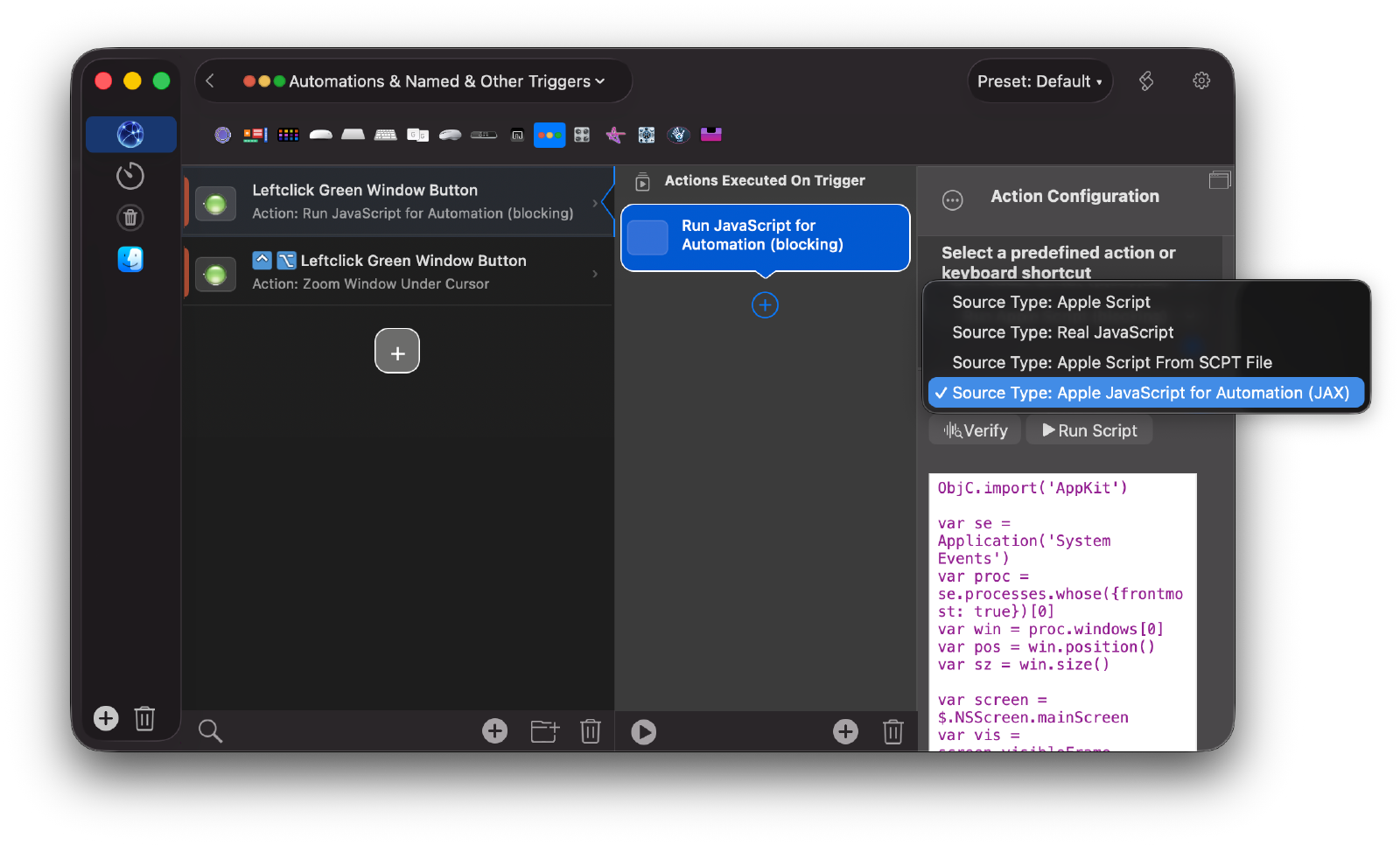
Now – and this is important – click the “Source Type” dropdown (it defaults to “Apple Script”) and change it to “Apple JavaScript for Automation (JAX)”.3 This gives us access to macOS’s Objective-C bridge, which we need to query the actual usable screen dimensions.

The Source Type dropdown expanded, showing “Apple JavaScript for Automation (JAX)” as the selected option

Paste in the following script:

ObjC.import('AppKit')

var se = Application('System Events')
var proc = se.processes.whose({frontmost: true})[0]
var win = proc.windows[0]
var pos = win.position()
var sz = win.size()

var screen = $.NSScreen.mainScreen
var vis = screen.visibleFrame
var full = screen.frame

var topY = Math.round(full.size.height - vis.origin.y - vis.size.height)
var usableHeight = Math.round(vis.size.height)

win.position = [pos[0], topY]
win.size = [sz[0], usableHeight]

What this does: it reads the frontmost window’s current position and size, queries NSScreen for the usable screen rectangle (the area between the menu bar and the Dock), and then repositions the window to the top of that rectangle and stretches it to the full usable height – without touching the width or horizontal position.

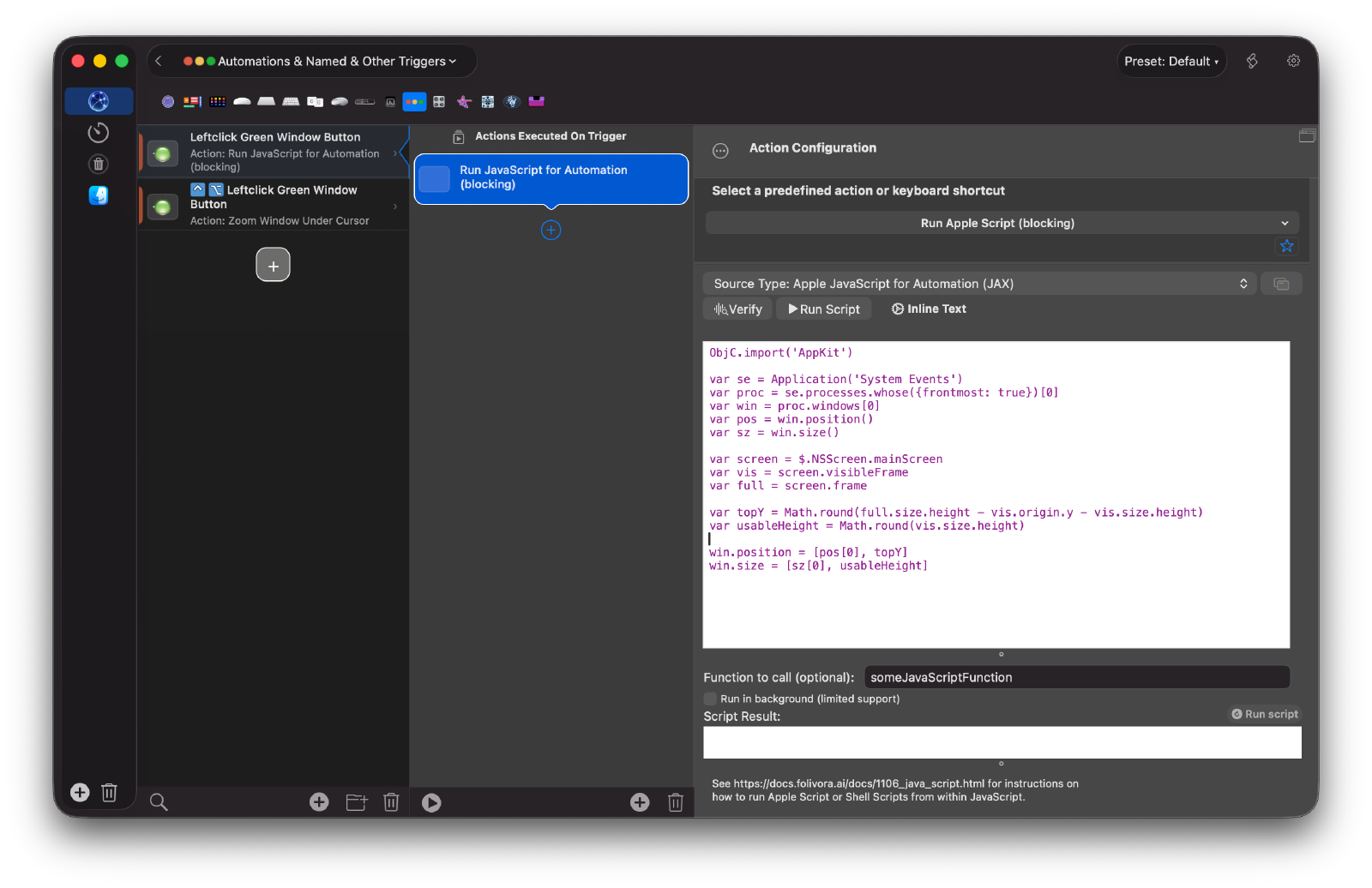
Make sure the “Function to call” field is empty. If there’s anything in it (BTT sometimes pre-fills “someJavaScriptFunction”), delete it – otherwise you’ll get an OSAScriptErrorNumberKey = "-1708" error.

The complete action configuration with the JXA script pasted in, the Function to call field empty, and Source Type set to JAX

Step 3: Try it

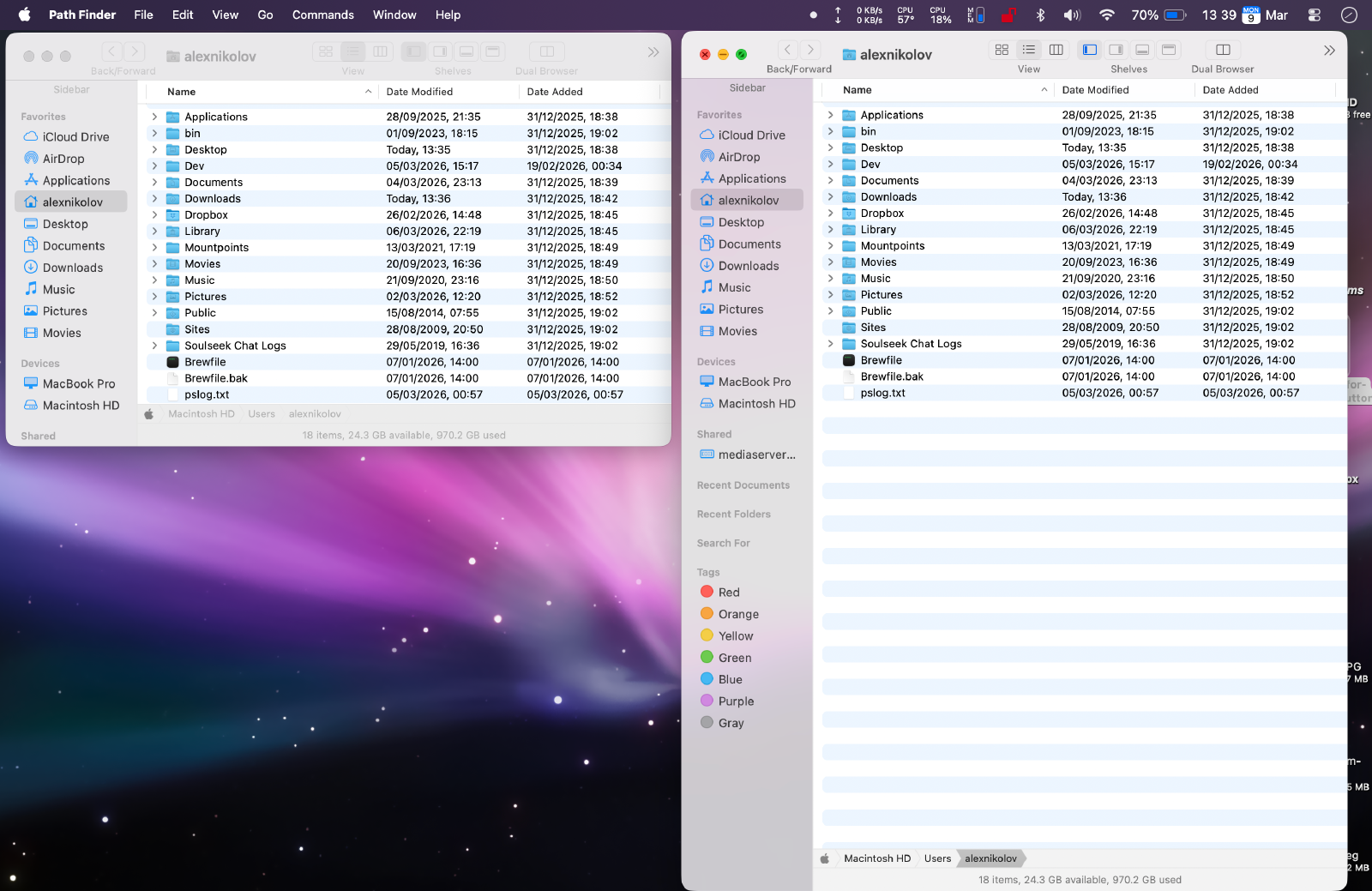
Open a Finder window, make it smallish and somewhere in the middle of the screen, then click the green button. The window should snap to full height while staying at its current width and horizontal position.4

A Finder window before and after clicking the green button – same width, now full screen height

Optional: Restore Option-click Zoom

If you’d also like Option-clicking the green button to trigger the traditional macOS Zoom behaviour (the app-defined “useful resize”, which may also change width), you can add a second trigger:

  1. Add another “Leftclick Green Window Button” trigger.
  2. In the trigger configuration on the right, change the opt modifier dropdown from “any” to “required”.
  3. For the action, choose the built-in “Zoom Window Below Cursor” (under Window Interaction).
  4. Go back to your first trigger and change its opt dropdown to “not pressed” – this ensures the two triggers don’t overlap.

Now a plain click gives you the full-height behaviour, and Option-click gives you the classic Zoom.

The tiling popover problem

There is one small remaining annoyance: in Tahoe, hovering over the green button for about a second triggers a tiling popover menu. BTT’s trigger fires on click, but if your cursor lingers on the green dot, macOS shows its popover and your click may land on a tiling option rather than reaching BTT.

In practice, a quick deliberate click usually beats the popover. If it becomes a persistent irritation, you can disable some of the associated tiling behaviour in System Settings → Desktop & Dock by toggling off the drag-to-tile options, though as of Tahoe there isn’t a clean toggle specifically for the green button popover.

Why not just use the built-in Zoom action?

BTT has a built-in action called “Zoom Window Below Cursor” which calls the native macOS performZoom: API. You might think this is the obvious solution – and for years, on older macOS versions, it was. The problem is that Zoom is app-defined: each application decides what “zoomed” means, and many apps will change the width as well as the height, or do something else entirely. The JavaScript approach above is deterministic – it always keeps your width and always goes full height, regardless of what the app thinks Zoom should mean.

That’s it. This approach should also work on earlier versions, though you’re less likely to need it. Three minutes of setup to undo several years of Apple slowly making windows worse.

Final Thoughts

I should say: I’m not against change per se. Operating systems evolve, interfaces get rethought, and most of the time the right response is to adapt and move on. Not every UI change is a regression – plenty are genuine improvements, and plenty more are lateral moves where reasonable people can disagree.

The old Zoom behaviour had its critics too. But when you do make changes – especially ones that override a decade of established muscle memory – you ought to give users a way to change things back. A toggle in System Settings, a defaults write command, something. The fact that Apple offers no way to restore the old green button behaviour would be frustrating enough if the new behaviour were merely different. It’s considerably more frustrating when the new behaviour is actively, measurably worse – a hover popover that fights your clicks, a “Fill” that ignores your window width, tiling that resets your layout the moment you drag anything.

Apple used to be better about this. The Mac used to be the platform where you could make it work the way you wanted. Increasingly, it’s the platform where you download a third-party utility to undo the choices Apple made for you.


  1. I missed this break in real time. Beginning with Mojave and eventually continuing until Monterey I started skipping or slow-upgrading the operating system updates, usually updating only when forced by (my then browser of choice) Safari Technology Preview ceasing to support the OS. In 2023 I got a desktop gaming PC and gradually switched to using it full-time. My old 2018 MacBook Pro became more and more sluggish and eventually the battery gave out completely, and I didn’t replace it until December 2025, at which point the new machine came with Tahoe. I went from Monterey straight to Tahoe, skipping Ventura, Sonoma (the last to support my old MacBook), and Sequoia entirely, and experienced the full accumulated delta in one go. The green button had become unrecognisable. ↩︎

  2. Full Screen mode on macOS has always struck me as an answer to a question nobody was asking. “What if we took the thing that makes a desktop operating system a desktop operating system – overlapping, freely-arranged windows – and got rid of it?”. It actually used to be a common criticism of Mac OS X that the green button didn’t actually maximise windows like its equivalent on PCs did – but on Windows maximising a program doesn’t obscure the Start Menu or hinder your ability to switch programs with the GUI. ↩︎

  3. Yes, it says JAX, not JXA. BTT has its own relationship with acronyms. ↩︎

  4. The screenshot below shows Path Finder rather than Apple’s Finder. Path Finder is a long-standing third-party Finder replacement that offers dual-pane browsing, a more capable toolbar, and – crucially for me – a sidebar where folders still have distinct, colourful icons rather than the identical monochrome folders that Apple’s Finder now uses. Its window chrome also still looks like a Mac application rather than a translucent soap bubble. The script works identically on both; it resizes whatever the frontmost window happens to be. ↩︎

Say Hello to Bubs

My wife was complaining that my posts so far have been too computer focused, so here instead is a picture of my cat Bubs. He name is short for Beelzebub, and was coined by my fried Rigo, who did so after cat-sitting her as a small kitten, where she terrorised his housemate’s (much older and larger) cat.

A tabby kitten biting a toy mouse.

She is a now a “mature” 9-year-old tabby/Siberian mix.1 Her birthday is January 27th, 2017.

A cat sleeping on a radiator bathed in sunlight.
A fine ’napper’, even if a poor mouser.

She loves food, running around at high speed, going on top of my kitchen counters when I am not looking, and most of all she loves the radiator (pictured below). In winter, when the radiator could be on all day, she will glue herself on it like an English tourist at a poolside in Corfu, occasionally flipping herself over as to not overcook. I once measured her surface temperature with a laser thermometer and it was 49ºC, placing her in the ‘rare’ in the beef temperature cooking charts.

A cat sleeping on a radiator next to a stack of books.

I wish someone loved me as much as that cat does the radiator.


  1. At least that is what the two slightly crazy-looking ladies we bought her from claimed about her pedigree. ↩︎

An Ode to an Old Friend

The very first computer I truly considered my own was a 2008 black polycarbonate MacBook with an Intel Core 2 Duo, 4GB of 667 MHz RAM and a (whopping for the time) 250GB of storage. I still remember begging my mother to get the higher capacity model, and her incredulity at the very idea of 250 whole gigabytes of storage, (“You’re never going to fill it!”). Now my Photos library alone is over 253 GB in size, and is so large it takes Finder ~30s to calculate the size. The past really is a different country (and indeed this will very much be the theme of this blog post).

People get very sentimental about the computers of their youth; something I think is underrated as a strange and slightly absurd phenomenon. A lot of computers that people eulogise (particularly the early ones) aren’t just worse than today’s machines – which, of course they are – they’re also practically unrecognisable as the same kind of device. Think of the Commodore 64, with its now-alien, screen-less keyboard body, command-line interface, and unintelligible keys (“RUN STOP” anyone?). Yes, they were pioneering and historically important. Yes, they helped bring computing to a wider public. But they were also full of limitations and compromises that are too often airbrushed away.

In one sense, perceived performance has not changed as much as the hardware has. Your phone gets a faster processor every year, but the software bloats to match, so the net experience barely moves. But that kind of observation I think really undersells the underlying reality of technological progress.

Overall though, I think most nostalgia is totally misplaced – ridiculous even.1 That original PowerBook 100’s lead acid2 battery could, optimistically, manage perhaps 3.5 hours of battery life – and it was at that time a market leader! The much more typical IBM ThinkPad 350C could barely manage 2 hours. It would be another two decades before laptops regularly managed much above five or six hours. That PowerBook also cost $2,500 (equivalent to $6000 in 2025), weighed 2.3kg 3 and had a 640 × 400 black-and-white display that was dimmer, lower-contrast, and more angle-sensitive than the active-matrix screens that followed (themselves poorly remembered today!).

Were I to go over every single example of how computers have got better in my lifetime this essay would quickly become a short book. If you want to read that catalogue, I recommend Gwern’s excellent essay on the subject. Suffice it to say, I think rose tinted glasses are rarely if ever a helpful analytic for looking at the past.

That said I really do think that first MacBook I had was an exceptional computer!

Far more than most of its predecessors, it feels like a machine a modern user could still instantly recognise. It was relatively thin for its time, with a widescreen, glossy, reasonably colour-accurate display. The MacBook was among the first wave of Apple laptops to adopt the MagSafe power connector, and was the first to ship with the sunken keyboard design and the non-mechanical magnetic latch. It shipped with a DVD±RW/CD-RW “SuperDrive”. That meant not I only could I watch DVDs in the car (just like the kids with parents who could afford cars with built-in screens in the seat backs), but write DVDs and make mix CDs to give to my friends and family! It was offered with the then astronomical aforementioned 250GB – nearly twenty years later and I am writing on a computer that has 6x the RAM, over 11x the memory bandwidth, but only 4x the storage at 1TB. The just-announced MacBook Neo, as of time of writing, comes with just 8GB of RAM and starts at 256GB of storage – 18 years later!

In some ways it was actually better than later generations of computers that Apple shipped. It had an amazing keyboard that was and even now still is superior to the current line of keyboards on Mac laptops, with a key travel distance of 1.5 mm (vs only 1 mm in the current generation of Magic Keyboards, and an absolutely abysmal 0.7mm in the butterfly switch era keyboards).4

The polycarbonate MacBooks were also much easier for users to fix or upgrade themselves than either their predecessor or successors. Where the iBook required substantial disassembly to access internal components such as the hard drive, (later Macs had the SSDs soldered on the motherboard), the MacBook required that users only remove the battery and the RAM door to access or replace the hard drive. 5 Apple even provided easy to follow do-it-yourself manuals for these tasks on the Apple website. Even the bottom case screws were just ordinary Phillips heads!

It wasn’t all sunshine and roses for sure. One long-forgotten aspect of computers of that era, (the MacBook being no exception), was that booting them up was a process that took 3-4 minutes. You would typically press the on button and then get up and go do something else – although I can no longer imagine what given that smart phones weren’t common and of course your only computer was stuck booting for another 3 mins! 6 An actual selling point of this MacBook was that it had a claimed “near instant” boot time at merely ~2 minutes!

Then once it was successfully on, there was no guarantee that it would stay running, with a constant low-grade anxiety being that it might crash or kernel panic and you would lose potentially hours of work. Before Apple introduced continuous save states, users would develop a tic to constantly hit Command-S every few minutes, lest their beloved Mac kick the bucket mid-sentence. Right now I am typing this essay in Byword, and have not manually saved it once. I might not ever! It doesn’t matter as even if the app crashes my work is probably saved – and that’s if it crashes. A very improbable if.

Overall though I am confident that had I been 33 in 2008, and decided to write an essay looking back at my first computer from the year 1990, it is very unlikely I would have been able to look back to a computing device that so resembled the device I would have been writing it on. Like the 2008 MacBook (first launched in 2006!) is recognisably the same species of computer that the 2026 MacBooks are, in a way that the PowerBooks of the early 90s really weren’t.

I think what made the black MacBook special wasn’t that it was the best at anything in particular. It wasn’t the fastest, or the lightest, or the most capable machine you could buy in 2008. What made it special was that it was the point at which the laptop as a form basically settled into what it still is today. Thin-ish, wide-screen, instant-on (well, near enough by the standards of the time, and certainly aspirationally). A keyboard you could actually type on. A trackpad you could actually point with. A screen you could actually look at for hours without your eyes staging a walkout.

If the PowerBook 100 was the proof of concept, and the titanium PowerBook G4 was the prototype, the MacBook was the first draft that an editor would recognise as essentially the same book. Nearly two decades later I’m typing on something that is unambiguously, incomparably better in every measurable dimension 7 – and yet if you put the two side by side, a stranger would immediately clock them as relatives. The same cannot be said of almost any other eighteen-year gap in computing history.

I don’t think that makes the nostalgia rational, exactly. My current machine would annihilate that old black MacBook in (almost) every hardware benchmark and I’ll even begrudgingly admit most software ones too. But it does make the nostalgia intelligible, which is more than I can say for anyone getting misty-eyed over a Commodore 64. 8 The MacBook wasn’t a relic from a lost world. It was the first citizen of this one.

Rest in peace, old friend! Whether or not you actually did transform the world of portable computers, you absolutely did transform my personal world. You definitely earned your eulogy!


  1. I think there are a lot of parallels to be seen in how people wax nostalgic about vintage cars from the 1980s and 1990s. Cars that were objectively shit then, and are even shittier now get spoken about in hushed, reverent tones. Like sometimes people focus on relatively superficial improvements like power windows (though I don’t think they are that trivial), but I think the bigger differences are things that are so normalised that it’s hard to imagine driving without them. If it was a car you could actually afford in the 1980s and 90s, it almost certainly wasn’t a car with power steering, and more likely than not lacked a collapsible steering column. I am juuuust old enough to have driven a manual steering car – really awful! – and would basically never consider getting behind a wheel that would for sure impale me through the sternum in a low-speed collision. ↩︎

  2. Yes ’lead acid’ like the 12V starter battery in your car. Another unflattering automotive parallel ↩︎

  3. Almost unbelievably, a whopping 4.5kg less than its immediate predecessor, the Apple Portable Backlit ↩︎

  4. To quote John Gruber of Daring Fireball fame, “the worst products in Apple history”. Truly one of the worst keyboards ever shipped by anyone full stop. I had one in my 2018 MacBook Pro 15" until I upgraded to a M5 MacBook Pro last year, and let me tell you it was awful. 0.7mm barely felt like you were pressing a key, the Touch Bar required you to look down and prevented you from developing muscle memory, the minimal space between the keys meant it was super easy to mistype and worst of all I had to live in fear for 7 long years that a speck of dust might cost me hundreds of pounds of repairs. They earned a well deserved spot in the dustbin of history↩︎

  5. I myself even remember upgrading the RAM from 4GB to 6GB. RAM you could upgrade yourself in an Apple designed laptop! A different country indeed! ↩︎

  6. Man, what did I do? Just sit and stare at it? Read a book? ↩︎

  7. A stark and very sad contrast to the software of macOS ↩︎

  8. Or worse the BBC Micros that my fellow Brits wax nostalgic about. Some of my parents generation even try and tell me that their Pravets-16 were worth celebrating! Crazy people the lot of them. ↩︎

From the Folder to the Web

For a very long time I have had a folder on my Mac sitting full of writing. Some of it looked like actual blog posts, some of it rants, some of it just a handful of sentences denoting the start of an idea. This blog is my small attempt to move beyond just writing for the folder to writing for the web, (or at least the AI scrapers who I suspect will probably be my only readers!). Hello to you all! Hello World if I may!

I will do my best to write to this blog, but realistically it will probably be sporadic. I set it up using Hugo, and it’s not as frictionless as I had hoped (for example I had to write a script to push to GitHub to post, and images are kind of a nightmare to embed). That said it was kind of illuminating making it, and Hugo isn’t particularly challenging to get your head around.

It’s especially easy with my AI helpers: one of the most remarkable parts of the modern world is just how easy it has become to build things for the web! Even without the LLMs, the web is full of publishing tools, software and components that make what used to be a fairly abstruse process much more accessible. In his classic Turing Award lecture “Reflections on Trusting Trust” (published in Communications of the ACM, August 1984), Ken Thompson wrote

“You can’t trust code that you did not totally create yourself. … No amount of source-level verification or scrutiny will protect you from using untrusted code.” Ken Thompson 1

It’s funny, I am not really a developer – my day job is being a chef! – and taking his words at face value the rise of ‘vibe coding’ probably does in a literal sense flood the world with software whose authors, (let alone their users), don’t understand even if it’s easier than ever to compile. In another sense, though, I think something more interesting is happening.

In 1984, let alone 2008 when I got my first Mac, the idea that an ordinary user might compile and examine the code running on their machine was a complete abstraction. You used what you were given and you trusted it because you had no choice. Now, for the first time, I feel genuinely closer to that possibility – and it’s precisely thanks to AI. Not as a passive consumer of prompt outputs, but as someone using these tools to learn, to understand, and to participate proactively in the software I run. This website has no tracking (other than anything I might embed), unlike virtually every other site or application I might use in my day-to-day life. I have found the last few weeks of building things liberating and deeply meaningful on a personal level.

Nearly 20 years ago my mother purchased me my first Macintosh – a black polycarbonate “MacBook” circa mid-2008. I had had hand-me-down Windows computers that my dad had given/set up for me, but this was truly the first device I owned that was a personal computer. It was a tool, yes, but it was also a window into the world that profoundly transformed how I lived my life, my views and understanding of the world. A bicycle for the mind indeed! 2

With this machine, unlike the earlier PCs, I was free to use it in whatever way I liked (especially, from my mother’s perspective, to do homework). I often struggle to communicate to people what a extraordinary experience it was to encounter Mac OS X at the time. The colourful icons, the slick interface, the beauty and simplicity of UNIX – it was a tremendous contrast to Windows which I had always used because I had to, and had never really understood intuitively the way I ended up understanding Mac OS.

It was through Mac OS Leopard and the bundled iWeb application that I first experimented with publishing a website. iWeb allowed users to create and design simple websites and blogs without coding and included a number of Apple-designed themes, each of which had several page templates which you could then use to publish to MobileMe, a now long gone precursor online suite to iCloud. I can’t remember exactly what my first site was supposed to be (maybe some kind of class election or vote? It has been a long, long time!), but I thought I would mention it as an artefact of that bygone world. It strikes me how enticing the idea then (as now!) was to just get on the web. I remember living my life feeling like nothing was really real, and consequently making a site felt like becoming more real somehow.

I don’t think I am a particular amazing writer, but then again how could I expect to be? Writing, though to a certain degree a form of thinking, is very much a skill that comes with practice. That folder that has sat on my Mac for these last 18 years has long been my attempt to get better at thinking about things, but always privately, always for myself. Similar to coding, or making a website you never get better or good at the things you never attempt. Publishing, even to an audience of scrapers, will hopefully push me to try and making something more of my thoughts.

If nothing else it means a lot to me that I can sit here and try and make real what was previously stuck in a folder, waiting to become real.


  1. Astonishingly the man is still very much alive, and not only that but is apparently working at Google at the rip old age of 83. I will write a blog post about this eventually, but I think it’s kind of incredible that so many of the pioneers of Computer Science are not only still alive, but you too if you’re lucky enough to go to university to study CS can often be taught by them directly. Like imagine if you could study Physics and be taught by Richard Feynman or Economics and be taught by Bastiat or Schumpeter↩︎

  2. Thank you so much mum. Then and now it’s hard to communicate how much it meant to me. I doubt I will be able to ever to pay you back. ↩︎